
Introduction
If you have been paying attention to financial news in Nigeria over the past few months, you may have noticed something unusual — the Nigerian stock market is on fire. The NGX All-Share Index, which tracks the performance of all listed companies on the Nigerian Exchange Group, has surged by approximately 24% year-to-date as of early 2026. That is not a typo. At a time when many Nigerians are still navigating the effects of inflation, a weakened purchasing power from the previous naira devaluation, and rising living costs, the stock market has quietly been generating some of the most impressive returns in the country.
But here is the problem: most everyday Nigerians are not benefiting from it.
A large percentage of the wealth being created on the NGX right now is going to institutional investors, high-net-worth individuals, and foreign portfolio investors who already had positions in the market. The average Nigerian — the teacher, the civil servant, the young professional, the market trader saving money in a bank account, is watching from the sidelines without even realising there is a game being played.
This article is for that person. We are going to break down exactly what the NGX All-Share Index rally means, why it is happening, what the risks are, and most importantly, what you can do about it starting today.
What is the NGX all-share Index?
The NGX All-Share Index (ASI) is a number that represents the combined performance of every company listed on the Nigerian Exchange Group stock market. It is a single score that tells you whether Nigerian publicly listed companies — as a whole — are gaining or losing value.
When the index rises by 24%, it means that on average, across all listed companies, share prices have gone up by 24% since the beginning of the year. Some companies have done better than that. Some have done worse. But the overall direction is strongly upward.
The NGX currently hosts over 150 companies across sectors, including banking, oil and gas, consumer goods, agriculture, telecommunications, and manufacturing. When you invest in the stock market, you are buying small ownership stakes in one or more of these companies.
Why the Market Rallying?
Understanding why the market is going up helps you decide whether the rally is sustainable or just noise. Several key forces are driving the 2026 NGX surge:
- Declining Inflation Nigeria’s headline inflation has fallen significantly, dropping to around 15% from its painful highs above 30% in 2023 and 2024. When inflation cools, the Central Bank of Nigeria (CBN) can begin to ease interest rates. Lower interest rates make fixed-income investments like savings accounts and Treasury Bills less attractive, pushing investors toward the stock market in search of better returns.
- Naira Stabilisation The naira has found relative stability around the ₦1,350–₦1,390 per dollar range, following the CBN’s updated Bureau De Change policies and improving foreign exchange reserves. A stable naira reduces the currency risk that has historically scared away foreign investors. More foreign capital flowing into the NGX pushes prices up.
- Foreign Investor Confidence Major global institutions including Goldman Sachs and Bank of America have been increasing their stakes in Nigerian equities. The EBRD’s $100 million investment in Access Bank — its first-ever sub-Saharan Africa transaction — sent a powerful signal to the global investment community that Nigeria is open for business. When large institutions buy, prices rise.
- Corporate Earnings Growth Many listed Nigerian companies posted strong earnings results in 2025, particularly banks, oil companies, and consumer goods firms that benefited from the post-devaluation price adjustments. Higher earnings mean higher share valuations.
- Improved Economic Fundamentals Nigeria’s GDP growth is projected at 4.4% in 2026 — the strongest pace in over a decade — driven by oil sector recovery, digital economy expansion, and the effects of the Nigeria Tax Act 2025 reforms. When the economy grows, businesses grow with it, and stock prices reflect that.
What does this mean for you as a Retail Investor?
A 24% market return is extraordinary. For context, the average Nigerian savings account is currently paying between 8% and 12% per year in interest. Fixed deposit accounts might offer slightly more. But the stock market, in just a few months, has already delivered double or triple what those instruments would give in a full year.
Here is what that looks like in real numbers:
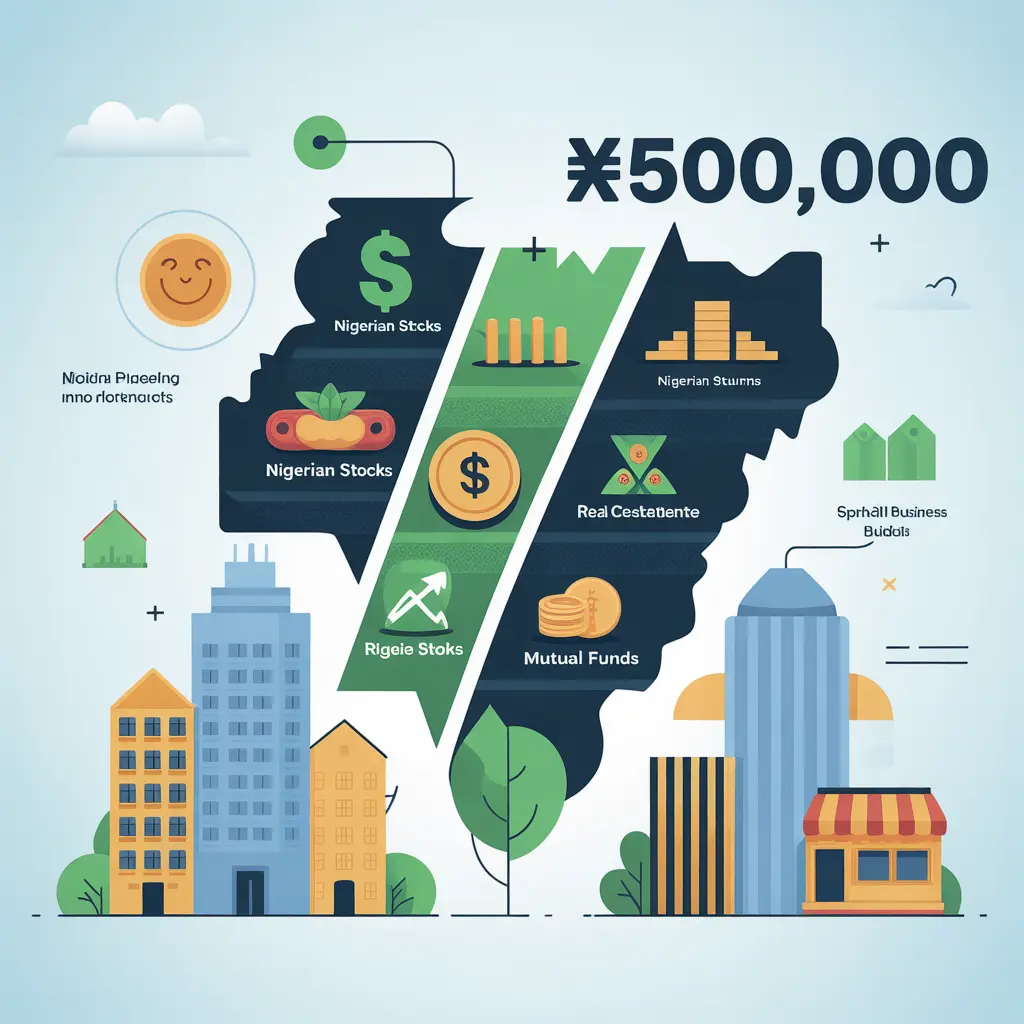
If you had invested ₦500,000 in a diversified portfolio of NGX stocks at the start of 2026, you would be sitting on approximately ₦620,000 today — a gain of ₦120,000. If that same ₦500,000 had been sitting in a savings account at 10% per year, you would have earned roughly ₦41,600 over the same period.
That gap is the opportunity cost of not participating in the market.
However — and this is critical — past performance is not a guarantee of future results. Markets go up and they come down. The fact that the NGX has risen 24% does not mean it will rise another 24% by December. It could pull back. There will be corrections. Some individual stocks will underperform badly even while the index looks healthy. This is why how you enter the market matters just as much as whether you enter.
The Risks you must Understand First
No honest conversation about stock market investing can skip this section. Here are the key risks Nigerian retail investors face:
- Volatility Risk: Stock prices can swing dramatically in short periods, especially in an emerging market like Nigeria. Political news, oil price shocks, or global economic events can wipe out gains quickly.
- Concentration Risk: Many Nigerian investors put all their money into one or two stocks — typically banks or Dangote companies because those names feel familiar. If those stocks drop, your entire portfolio suffers.
- Liquidity Risk: Unlike a savings account, you cannot always sell your stocks instantly at the price you want. Some NGX stocks are thinly traded, meaning there may not be enough buyers when you want to exit.
- Emotional Risk: This is the most underestimated risk. Seeing your portfolio drop by 10% can trigger panic selling at exactly the wrong time. Successful investing requires patience and discipline that most people underestimate before they start.
- Timing Risk: Jumping into a market that has already rallied 24% means you may be buying at elevated prices. If the market corrects after you buy, you could be in negative territory for months before recovering.
How to Start Investing in the NGX
If you are ready to participate, here is a structured approach:
Step 1: Open a stockbroking account. You need a SEC-registered stockbroker to buy and sell shares on the NGX. Many now offer digital platforms — Meristem, Cordros, Stanbic IBTC, and ARM Securities are among the reputable options. Account opening typically requires your BVN, a valid ID, and a bank account.
Earn over 20% with Stanbic IBTC Money Market Funds: https://www.stanbicibtcfundsmanagement.com/invest-now-x8p45e48
Step 2: Start with what you can afford to lose. This is not pessimism — it is realism. Your first investment should be money you would not need urgently for at least one to two years. A good starting point is between ₦50,000 and ₦200,000.
Step 3: Diversify from day one. Rather than picking one stock, spread your investment across at least three to five companies in different sectors — for example, one bank, one consumer goods company, one oil stock, and one industrial firm.
Step 4: Consider investing through mutual funds first. If stock-picking feels overwhelming, a Nigerian equity mutual fund gives you instant diversification managed by professionals. Several funds have outperformed the index this year, and minimum investments can be as low as ₦5,000.
Step 5: Commit to a long-term mindset. The NGX rewards patient investors. Plan to hold your investments for a minimum of three to five years. Do not check your portfolio every day. Set a review schedule — quarterly is sufficient for most beginners.
Invest in Nigerian and Foreign shares to enjoy passive income here: https://app.investbamboo.com/invite/anne162508
JOIN MY FREE TELEGRAM COMMUNITY (be the first to get informed) https://t.me/+SNSQzX94_Gk1M2M0
Conclusion
The NGX All-Share Index surging 24% in early 2026 is not just a headline for financial analysts. It is a real opportunity for ordinary Nigerians to build wealth — if they approach it with knowledge, discipline, and the right expectations.
The market will not wait for you to feel fully ready. Inflation is eroding the value of money sitting idle in low-yield accounts every single day. The question is not whether you should invest — the question is how you will do it wisely. Start small. Diversify early. Think long term. And come back to this blog every day, because we are going to walk through every aspect of this journey with you.