You’ve decided to start investing. You have money saved, you’re ready to grow it, and now you’re facing the biggest question every new investor asks: should I buy individual stocks or invest in index funds? The finance world is split. Some swear by picking individual stocks — the thrill of choosing winners, the potential for massive returns, the control over exactly what you own. Others argue index funds are the smarter choice — diversification, lower fees, proven long-term performance with minimal effort. For Nigerian investors, this decision gets more complicated. Our stock market operates differently from Western markets. Access to investment products varies. Currency considerations matter. Tax implications differ.
This guide breaks down both approaches specifically for Nigerian investors, shows you the real pros and cons of each, and helps you decide which strategy actually makes sense for your situation.
What Are Individual Stocks?
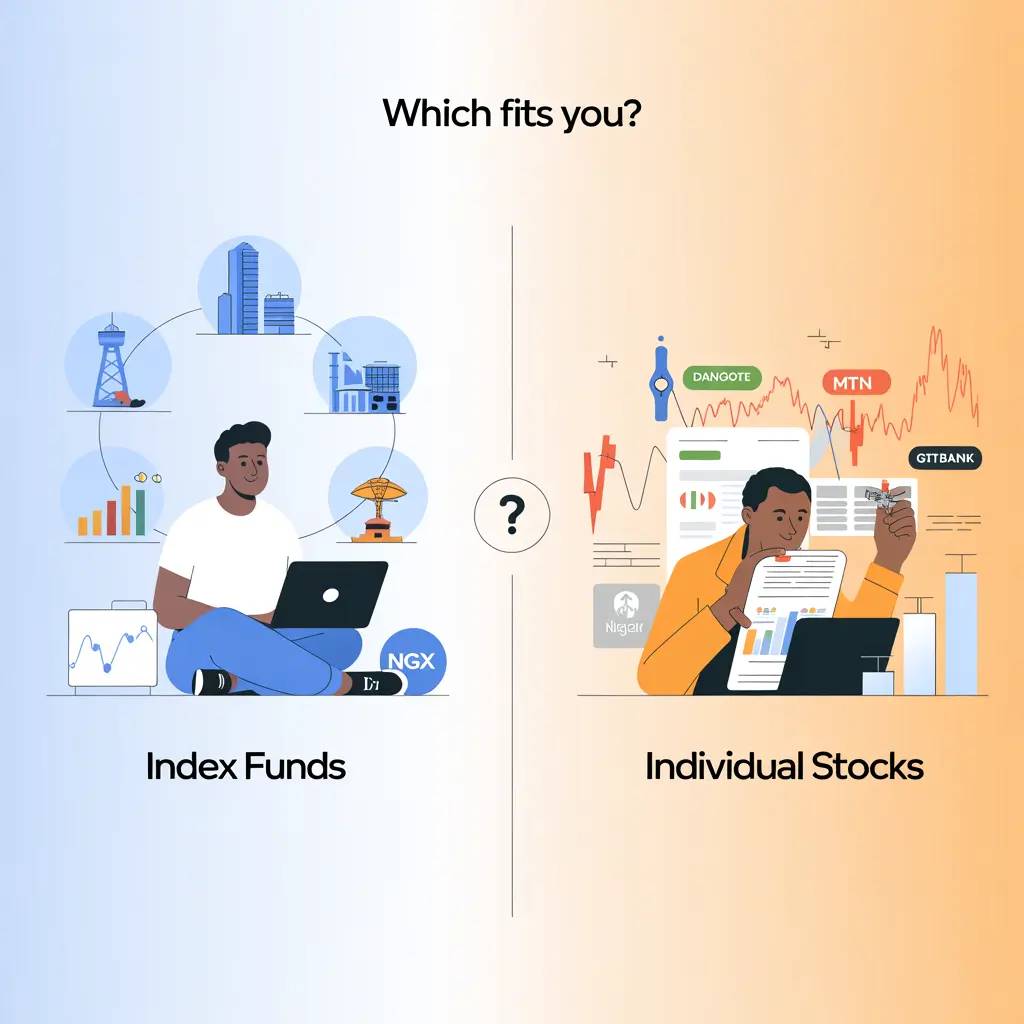
Individual stocks mean buying shares in specific companies — Dangote Cement, MTN Nigeria, Guaranty Trust Bank, Nestle Nigeria, or any company listed on the Nigerian Exchange (NGX). When you buy individual stocks, you’re making a bet on specific companies. If Dangote Cement grows and becomes more profitable, your shares increase in value. If MTN Nigeria struggles or faces regulatory issues, your shares might drop significantly.
The appeal is clear: if you pick the right companies, your returns can be extraordinary. Someone who bought MTN Nigeria shares early or invested in Dangote Cement during its growth phase would have multiplied their money many times over.
The risk is equally clear: if you pick wrong, you can lose substantial money. Companies fail. Industries decline. Management makes terrible decisions. Your entire investment in a single company can evaporate.
What Are Index Funds?
An index fund is a basket of many stocks packaged together that tracks the performance of a specific market index. Instead of choosing individual companies, you buy a slice of many companies at once. For Nigerian investors, the most relevant index is the NGX All-Share Index (ASI), which represents the overall performance of the Nigerian stock market. An index fund tracking the ASI would own shares in all or most of the companies listed on the Nigerian Exchange, weighted by their market size.
When you invest in an index fund, you’re essentially saying, “I believe the Nigerian economy and stock market will grow over time, so I want to own a piece of everything rather than guessing which specific companies will win.” The result? Your returns mirror the overall market. If the NGX rises 15% in a year, your index fund rises roughly 15% (minus small fees). If the market drops 10%, so does your investment.
No massive wins from picking the next MTN. But also no catastrophic losses from betting on the wrong company.
The Case for Index Funds
You Don’t Need to Be an Expert
The average person doesn’t have time to read financial statements, analyze balance sheets, attend annual general meetings, or track regulatory changes affecting specific companies. Index funds remove this burden entirely. You don’t need to know which banks are well-managed or which cement companies have the best margins — you own them all proportionally.
Diversification Protects You From Disaster
When you own 50+ companies through an index fund, a single company’s collapse barely affects you. If one bank fails or one manufacturer goes bankrupt, it’s a tiny fraction of your portfolio. Individual stock investors who concentrated heavily in companies like Skye Bank or Diamond Bank before their collapses lost everything. Index fund investors barely noticed because those companies represented small percentages of the overall index.
Lower Costs Mean More Money Stays Invested
Index funds typically charge annual management fees of 1-2% in Nigeria — some even lower. Actively trading individual stocks involves brokerage fees (usually 1-1.5% per transaction), SEC fees, and potentially capital gains taxes. If you’re buying and selling frequently, these costs compound and erode your returns significantly. With an index fund, you pay one small annual fee and that’s it.
The Data Favors Passive Investing
Studies consistently show that over long periods (10+ years), index funds outperform the majority of actively managed portfolios and individual stock pickers. This isn’t unique to Nigeria — it’s a global phenomenon. Most people who think they can beat the market by picking individual stocks actually underperform it after fees and bad timing decisions.
Time is Freed Up for Your Actual Life
Investing in index funds requires almost zero ongoing effort. You set up automatic monthly contributions, choose your fund, and forget about it. You’re not checking stock prices daily, reading quarterly reports, or stressing about earnings announcements. Your investment grows in the background while you focus on your career, business, or family.
The Case for Individual Stocks
Potential for Extraordinary Returns
The Nigerian stock market has created millionaires from people who identified growth companies early. If you bought Guaranty Trust Bank shares in 2003 or invested in Dangote Cement before it became a dominant force, your returns would dwarf what any index fund could deliver. Individual stocks give you the upside that index funds can never match.
You Control Exactly What You Own
Maybe you have strong convictions about certain industries or companies based on your professional expertise. Perhaps you work in banking and understand which banks are positioned for growth. Maybe you see consumer behavior trends before they’re reflected in stock prices. Individual stocks let you act on these insights directly rather than being forced to own companies you think are overvalued or poorly managed.
Nigerian Market Inefficiencies Create Opportunities
The Nigerian stock market is less efficient than developed markets, meaning quality companies can be underpriced for extended periods. Information doesn’t spread instantly. Not all companies are closely followed by analysts. This creates opportunities for informed investors to identify bargains that index funds buy indiscriminately based solely on market cap.
Tax Advantages on Dividends
In Nigeria, dividends from individual stocks can be more tax-efficient than fund distributions depending on your structure. You have more control over when you realize capital gains by choosing when to sell, potentially allowing better tax planning than a fund that might distribute gains automatically.
Lower Barrier to Entry
You can buy individual shares on the NGX with relatively small amounts of money through online stockbrokers like Bamboo, Risevest, or direct NGX-registered brokers. Some index funds have minimum investment requirements that might be higher than buying a few shares of a mid-cap stock.
The Real Challenges for Nigerian Investors
Before you choose one approach over the other, understand the unique obstacles Nigerian investors face with both options:
Limited Index Fund Options
Nigeria doesn’t have the abundance of low-cost index funds available in markets like the US. The options that exist often have higher expense ratios than their American equivalents. Some Nigerian fund managers actively pick stocks even within what they call “index funds,” which defeats the purpose. You need to research carefully to find true passive index tracking.
NGX Market Liquidity Issues
The Nigerian Exchange has lower trading volumes than developed markets. Some individual stocks, especially mid and small-cap companies, can be difficult to sell quickly without moving the price against you. This liquidity risk affects both individual stock investors (who might not be able to exit positions easily) and index funds (which must hold illiquid positions).
Currency Devaluation Risk
Whether you choose individual stocks or index funds, if they’re denominated in naira, your returns can be eroded by currency devaluation. A stock that rises 20% in naira terms might represent only a 5% gain in dollar terms if the naira weakens 15% that year. This affects both strategies equally unless you diversify into dollar-denominated investments.
Information Asymmetry
Retail investors in Nigeria often get information after institutional investors and insiders. By the time good news reaches the public, stock prices may have already moved. This disadvantage affects individual stock pickers more than index fund investors who aren’t trying to time specific company events.
Regulatory and Corporate Governance Issues
Nigerian companies occasionally face sudden regulatory changes, corporate governance problems, or unexpected management actions that can devastate share prices overnight. Index funds spread this risk across many companies. Individual stock holders bear the full brunt if they’re concentrated in the wrong company.
Which Strategy Actually Makes Sense for You?
The right choice depends on your specific situation. Here’s how to decide:
Choose Index Funds If:
You’re a beginner with less than two years of investing experience. The learning curve for successful individual stock picking is steep, and expensive mistakes are likely. Index funds let you participate in market growth while you learn.
You have a full-time job or business that consumes most of your time and mental energy. Picking individual stocks requires significant ongoing research and attention. If you can’t commit several hours weekly to analyzing companies, you’re likely to make poor decisions based on incomplete information.
You’re investing for long-term goals like retirement that are 10+ years away. Index funds excel over long time horizons because short-term volatility smooths out and market growth compounds. The longer your timeline, the more index funds make sense.
You want to minimize stress and emotional decision-making. Individual stocks trigger emotional responses when they drop 30% or surge 50%. Index funds are boring by design, which is psychologically easier to hold through market turbulence.
You’re starting with a relatively small amount of capital (under ₦500,000). Building a properly diversified portfolio of individual stocks requires enough money to buy meaningful positions in at least 10-15 companies. Below that threshold, you’re either under-diversified (risky) or buying such small positions that transaction fees eat up your returns.
Choose Individual Stocks If:
You have specialized knowledge or professional expertise in specific industries. If you’re a telecom engineer who understands 5G infrastructure or a banker who can analyze financial statements expertly, you have an edge that makes individual stock picking more viable.
You enjoy researching companies and find the process intellectually engaging rather than burdensome. Some investors genuinely love reading annual reports and tracking corporate strategy. If this describes you, individual stocks can be rewarding beyond just returns.
You have enough capital to build a properly diversified portfolio of at least 10-15 stocks across different sectors. This requires at least ₦1,000,000-2,000,000 to do meaningfully while keeping transaction costs reasonable as a percentage of your investment.
You’re willing to hold for the long term despite volatility and can resist the urge to panic sell during downturns or FOMO buy during bubbles. Emotional discipline is the difference between success and failure with individual stocks.
You understand that you might underperform the index and accept that risk in exchange for the potential to outperform. Most individual stock pickers lose to index funds over time, but some win big. You need to be honest about whether you have the skill and discipline to be in the winning minority.
Practical Implementation for Nigerian Investors
If You Choose Index Funds:
Research Nigerian fund managers offering true index tracking products. Stanbic IBTC, ARM Investment Managers, and some others offer funds that track the NGX. Compare expense ratios carefully and confirm they’re actually tracking an index rather than actively selecting stocks.
Consider dollar-denominated index funds through platforms like Risevest or Bamboo that give you access to US market indices like the S&P 500. This provides diversification beyond Nigeria and protection against naira devaluation. Set up automatic monthly investments rather than trying to time the market. Naira-cost averaging (the Nigerian equivalent of dollar-cost averaging) means you buy more shares when prices are low and fewer when prices are high, smoothing your average entry price.
Plan to hold for at least five years, preferably ten or more. Short-term market movements are noise. Long-term trends are signal.
If You Choose Individual Stocks:
Open an account with a reputable stockbroker. Online platforms like Bamboo and Risevest work for both local and international stocks. For NGX-only investing, consider established brokers with good online platforms. Start with Nigerian blue-chip stocks that have long track records, strong balance sheets, and consistent profitability. Companies like Dangote Cement, MTN Nigeria, Nestle Nigeria, and major banks are more stable than small-cap speculative stocks. Diversify across at least five sectors (banking, consumer goods, telecoms, energy, industrials) so that sector-specific problems don’t destroy your portfolio.
Buy with the intention to hold for years, not trade frequently. Short-term trading typically generates losses for retail investors due to fees, bad timing, and emotional decision-making. Reinvest all dividends rather than spending them. Compound growth is your most powerful tool, but it only works if you let it run.
The Bottom Line: What Works for Most Nigerian Investors
For the majority of Nigerian investors — people with full-time jobs, moderate capital to invest, limited time for research, and 10+ year time horizons — index funds are the better choice. They’re simpler, less risky, proven to work over long periods, and free up your time and mental energy for things that probably matter more than trying to beat professional fund managers at their own game.
Individual stocks make sense for a minority of investors who have genuine expertise, sufficient capital to diversify properly, and the emotional discipline to hold through volatility without panic. The uncomfortable truth most finance influencers won’t tell you: picking individual stocks is statistically likely to underperform just buying the market through an index fund. Your time might be better spent increasing your income than trying to outsmart the market.
But if you love the process, have real knowledge, and want to take that shot, individual stocks offer the possibility of exceptional returns that index funds can never deliver.
Choose based on your actual situation, not based on what sounds exciting or what worked for someone else. Both paths can build wealth if followed consistently over decades.
Earn over 20% with Stanbic IBTC Money Market Funds: https://www.stanbicibtcfundsmanagement.com/invest-now-x8p45e48
Your Action Plan This Week
If you’re leaning toward index funds, research available Nigerian index funds and dollar-denominated options. Compare expense ratios, minimum investments, and track records. Open an account and make your first contribution, even if it’s small.
If you’re leaning toward individual stocks, identify one sector you understand well. Research the top three companies in that sector. Read their most recent annual reports. Start with one stock purchase to learn the process, then expand gradually as you gain experience and confidence.
If you’re unsure, start with the hybrid approach: put 80% into an index fund and use 20% to buy one or two individual stocks you’ve researched. This gives you experience with both while minimizing risk.
The worst decision is not choosing at all. Even an imperfect investment strategy executed consistently beats perfect strategy that never starts.
Invest in a High-Yield Savings Account (don’t settle for 3% banks give you when you can get 20% on your savings): www.app.optimus.ng/register?ref=4de524
JOIN MY FREE TELEGRAM COMMUNITY (be the first to get informed) https://t.me/+SNSQzX94_Gk1M2M0